
Academy
Module: Shopper conversation design
How fashion intent (occasion, silhouette, budget) should map to in-catalog actions.
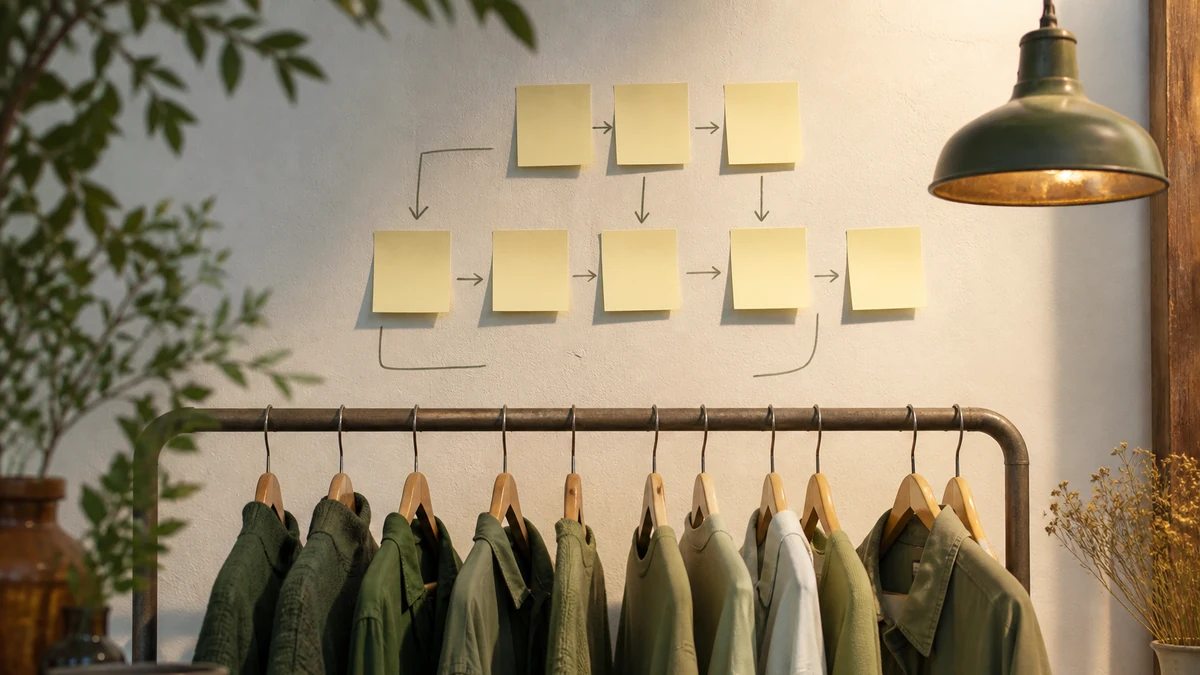
Design conversations that end in store actions, not essays. This module is reading-only. Fashion intent—occasion, silhouette, budget—should map to in-catalog actions the shopper can verify on a PDP.
The job is not to sound like a stylist magazine. The job is to preserve constraints across turns and resolve them against the connected catalog. If your design ends in a paragraph of styling advice with no SKU, you have built a magazine, not a store assistant.
A useful conversation has an exit
- Exploration: the shopper describes a need, recipient, occasion, or style direction.
- Narrowing: available attributes reduce the set.
- Evaluation: known differences among in-catalog options.
- Decision: product page, variant, eligible try-on visualization, or cart step.
Each turn should earn its place. Asking for a color preference when every available option is black wastes time. Asking for formality when the catalog spans evening and casual may change the set. If the catalog cannot use the answer, do not collect the preference as if it were a fact.
Study path
- Read Conversational Product Discovery.
- Read AI Shopping Assistant.
- Read Complete the Look so pairing is a SKU action, not a vibe.
- Write three real PDP questions from your store and the catalog fact each requires.
Practice
Take three real PDP questions from your own store. Write the catalog fact required to answer each. If the fact is missing, the work is merchandising data. Examples: “Is this midi?” needs a length field or a consistent description you are willing to treat as source. “What goes with this skirt?” needs accessory or top SKUs and a pairing rule. “Do you ship to this region?” needs knowledge, not a product tag.
Guardrails to keep in the design
- Do not invent complementary products.
- Do not invent fit.
- Do not skip availability.
- Do not treat Virtual Try-On as an exact-fit assessment.
- Do not invent discounts.
Fashion-specific traps
Occasion language is rich and weakly encoded. “Garden wedding” may mean length, fabric, and formality. If those are not in data, the assistant should not hallucinate a dress code. Size intent (“I usually wear…”) is not a license to assign a variant the shopper did not choose. Budget is only usable if price is in the catalog you connected.
Complete-the-look turns should name SKUs the shopper can open. If merchandising has not enabled pairing rules, do not design a conversation that promises an outfit. See the rules guide in Guides.
Failure modes
- A script that always asks the same three lifestyle questions regardless of catalog.
- Handoffs to a collection URL that dumps the constraints the shopper already stated.
- Evaluation language that ranks quality (“best,” “premium”) without a catalog basis.
- Designing for a chatbot containment metric instead of a product action.
Policy turns versus product turns
A useful design recognizes whether the shopper is asking about a garment or a store process. Shipping, returns, and lead times belong in knowledge. Size existence belongs in variants. “What goes with this?” belongs in pairing rules and SKUs. Mixing those sources produces fluent answers that contradict the PDP or the footer policy.
Read Store Help and Product Q&A so policy turns have a home. Do not design a conversation that promises order tracking this product does not document.
Testing missions, not scripts
Write ten shopper sentences from real mail and PDPs. For each, name the exit (variant, PDP, eligible try-on visualization, cart step, or honest gap). If you cannot name the exit, the design is an essay. Run the missions on a staging theme after catalog and embed exist—not against an imaginary demo catalog.
Exit criteria
You can sketch a four-step journey for one shopper mission and name the catalog field or knowledge entry required at each step. You can explain how this differs from a support chatbot; the comparison article on the Blog is optional further reading, but this module stays on WardrobeIt’s product surfaces.
Related: Getting Started, Store Help and Product Q&A for policy turns, and Comparison Library if you are still placing the job versus other tools.
Design on real sentences
Pull ten messages from support, PDP comments, or ads. Classify each as product discovery, product evaluation, pairing, policy, or out of scope. Out of scope includes order tracking this product does not document. Design exits for the in-scope classes only. Conversational Product Discovery.
Follow-ups must change the set or the explanation. Do not collect lifestyle preferences the catalog cannot use. Do not end on styling advice with no SKU. Pairing requires SKUs and rules: Complete the Look.
Guardrail review
- No invented complements.
- No invented fit.
- No skipped availability.
- No unauthorized discounts.
- Try-on, if present, stays visualization.
Test on a staging theme with live SKUs after embed exists. Assistant overview: AI Shopping Assistant.
Exit before personality
If you cannot name the store action a turn is for, do not add the turn. Personality that does not change the in-catalog set is magazine copy. Fashion shoppers still need a PDP they can verify. AI Shopping Assistant.
Policy turns use knowledge. Product turns use catalog. Pairing turns use SKUs. Keep the sources distinct so fluent mixing does not contradict the footer. Store Help and Product Q&A.
A conversation that cannot name its next store action is an essay. Design exploration, narrowing, evaluation, and a PDP, variant, eligible visualization, or honest gap. Do not collect preferences the catalog cannot use. Conversational Product Discovery.