
What Is an AI Shopping Assistant for Ecommerce?
Understand shopping assistants, compare search and chat tools, and use a practical checklist to evaluate the journey from question to cart.
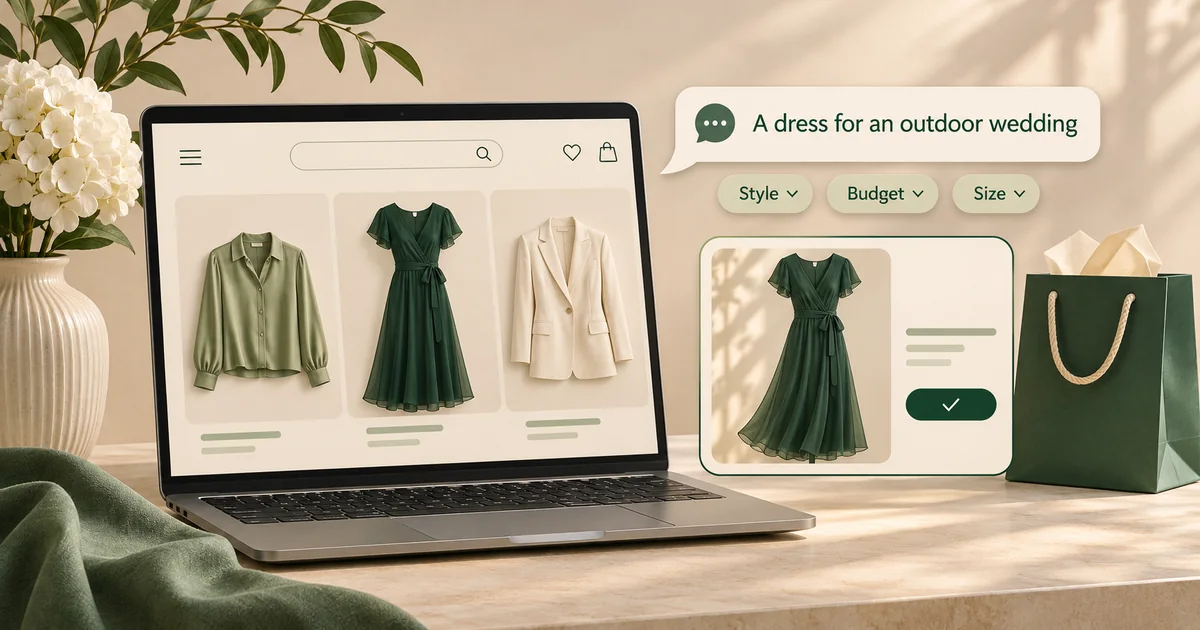
A shopper can know the occasion, budget and feeling they want without knowing your product names. Another may find the right item but hesitate over fabric, sizing or delivery. An AI shopping assistant can help connect those questions with the product information and actions your store supports.
An AI shopping assistant uses artificial intelligence to understand shopping requests and guide product decisions. On an ecommerce store, it connects customer intent with catalog items and approved knowledge. Depending on the implementation, it can recommend products, compare options, answer questions and help shoppers prepare a cart within defined permissions.
This guide explains the workflow, compares common shopping tools and gives merchants a checklist for choosing an experience that serves real customer needs.
See how WardrobeIt guides shoppers from question to cart. See How It Works
What is an AI shopping assistant?
An AI shopping assistant uses artificial intelligence to interpret shopping needs, find relevant products and support purchase decisions. On an ecommerce store, it connects a shopper’s request with catalog information and approved knowledge. Depending on the implementation, it can compare choices, answer product questions and help prepare a cart within defined permissions.
The word assistant describes its role in the buying journey. A shopper can explain an occasion, ask a follow-up question or change a constraint without starting over. The experience should retain relevant context while checking each answer against dependable information.
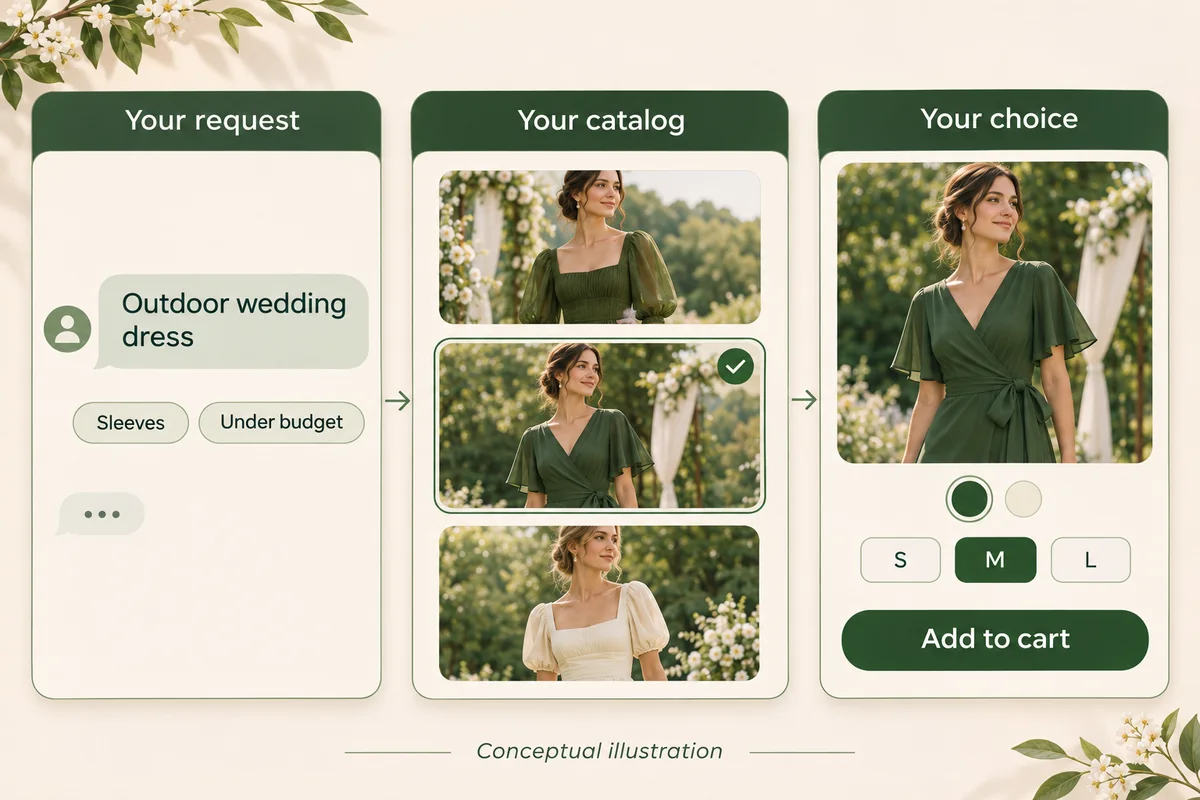
Example. Someone asks for a dress for an outdoor wedding and later adds that it needs sleeves. The assistant can refine the selection around that preference, then explain material or care information from the store’s approved sources. It should acknowledge gaps when the catalog cannot support an answer.
Shoppers also ask what is an online shopping assistant when comparing different tools. Some operate inside one store, while others help users explore products across retailers. Their information sources, purchase actions and relationship with the merchant can differ substantially.
For your store, define the permitted task before choosing the interface. An attractive conversation window does not tell you whether recommendations respect availability, whether answers reflect current policies or whether cart actions select valid variants. Those are the capabilities that make the experience dependable.
Keep conventional browsing and human support available. An assistant adds a useful route for shoppers who need guidance, while direct product pages remain important for people who already know what they want.
How an AI shopping assistant works on an online store
A useful workflow moves from understanding intent to retrieving facts, presenting options and confirming supported actions. The language model interprets the request, while connected commerce information supplies product identity, available variants and approved answers.
- Understand the request. Identify the occasion, budget, preferences and constraints the shopper has actually supplied. Ask a focused question if an important detail is missing.
- Find relevant catalog items. Match the request to products your implementation can retrieve. Apply availability and merchant rules before presenting a choice.
- Explain the recommendation. Give a concise reason tied to product information and the shopper’s stated needs. Avoid turning an uncertain inference into a product fact.
- Answer follow-ups. Use approved product and store knowledge for materials, sizing, delivery and returns. Clarify or route questions when information is missing.
- Confirm an action. Make the selected item, variant and quantity clear before a supported cart action. Continue through the store’s actual purchase flow.
These stages need separate checks. A correct product match can still produce a poor journey if the answer invents a delivery date. A helpful conversation can still fail if the selected size is unavailable by the time the shopper acts.
Review how it works with a realistic request from your catalog. Ask the provider to demonstrate a missing answer, an empty result and an unavailable variant. Reliable recovery tells you more than a demonstration built around a single ideal question.
Write down the source for each answer type. Product data, policy pages and human support each have a role. The assistant should use the appropriate source and make a clear transition when the request crosses its supported boundaries.
AI shopping assistant vs search bar vs chatbot vs product quiz
The right tool depends on how a shopper expresses the need and what help they require next. Search, quizzes and conversational tools can coexist. Evaluate their actual behavior instead of assuming that a product label determines its capabilities.
| Experience | Useful starting point | What to evaluate |
|---|---|---|
| Search bar | A known item, phrase or product attribute | Relevant results, synonyms, filters and empty-result handling |
| Product quiz | A repeatable choice with a defined set of questions | Question relevance, completion effort and recommendation logic |
| Ecommerce chatbot | A conversation or support entry point | Whether it only answers questions or also retrieves products and supports actions |
| AI shopping assistant | An evolving shopping need with follow-up questions | Catalog grounding, comparison quality, approved answers and purchase handoff |
A shopper searching a known product code may want immediate results. Someone choosing an outfit for a new occasion may benefit from discussing preferences. A short quiz can work well where the same few answers reliably narrow a category.
The more open the interaction, the more important its information boundaries become. A flexible assistant needs rules for unsupported product claims, questions involving personal circumstances and requests that do not match the catalog.
Our comparison of an AI shopping assistant vs chatbot explains how to evaluate these roles more closely. In a buying decision, request examples that cross discovery, questions and cart preparation so you can see which functions are actually connected.
Keep the first interaction lightweight. Do not force a conversation onto shoppers who can complete their task through search or direct navigation. A clear optional entry point makes assistance easier to discover without blocking the rest of the store.
What an AI shopping assistant can do for shoppers
A shopping assistant can help people move from an uncertain need toward an explicit product choice. The useful capabilities depend on the catalog, knowledge and actions available to the implementation. Review each stage as a separate customer task.
- Discovery. Interpret ordinary requests about occasion, style, price or product needs, then return relevant items.
- Comparison. Explain differences using known product attributes and the shopper’s stated priorities.
- Product questions. Surface approved information about materials, construction, care and policies.
- Sizing guidance. Help people locate and interpret the available size information, while qualifying missing measurements.
- Visual exploration. Offer an eligible virtual try-on preview when the implementation supports it.
- Cart preparation. Support a clear selection of product, variant and quantity before a permitted action.
Example. A shopper wants a lightweight layer for travel. The assistant can ask whether warmth or packability matters more, compare approved material details and show relevant jackets. If the store has no reliable information about garment weight, it should explain that gap rather than inventing a precise answer.
Appearance previews also need clear limits. A generated try-on image can add visual context, but it cannot establish physical comfort, exact color or guaranteed fit. Original product imagery and size guidance should stay accessible.
Good guidance leaves the shopper with control. Let people change their mind, open the original product page or ask for human help. The assistant should make the next action understandable and preserve the choices already made when something fails.
Test follow-ups that contradict an earlier preference. A shopper may change their budget or choose a different color after seeing results. The assistant must revise the selection consistently rather than keeping an outdated constraint hidden in the conversation.
What an AI shopping assistant does for merchants
For merchants, the opportunity is a clearer path between shopper needs, suitable products and measurable actions. Conversion, order value and reduced repeated questions are outcomes to evaluate. They should never be treated as guaranteed consequences of installing a tool.
Start with the problem you can observe. If shoppers cannot describe products in your catalog language, discovery may be the priority. If they repeatedly ask the same fabric question, approved product guidance may be more useful. A cross-sell experience belongs where an additional item genuinely complements the original choice.
| Merchant goal | Possible contribution | Evidence to review |
|---|---|---|
| Improve purchase progression | Relevant products and clearer buying answers | Recommendation engagement, cart actions and qualified purchase outcomes |
| Support order value | Useful complementary products or complete looks | Relevant item additions and order composition |
| Handle repeated questions | Consistent approved answers at the decision point | Answer quality, unresolved questions and support feedback |
| Understand demand | Recorded intent and objections within supported interactions | Recurring themes, catalog gaps and missing information |
Keep participation separate from causation. People who ask for help may differ from people who browse independently. Compare results with a suitable experiment before attributing incremental sales to the assistant.
Use insights to improve the store itself. Repeated requests for an unavailable sleeve length may inform merchandising. Repeated returns questions may reveal a policy page that is hard to find. Recorded conversations represent participating shoppers, so avoid presenting them as a complete view of market demand.
Assign operational ownership. Merchandising should review recommendations, CX should maintain approved answers and growth teams should define measurement. Clear responsibilities help the experience stay accurate as products and policies change.
Examples of AI shopping assistants in retail
Large retail platforms show how conversation, product information and visual discovery can work together. Their capabilities provide useful design lessons, while their catalogs and purchase flows differ from an independent store’s implementation. The examples below reflect official descriptions reviewed in November 2026.
| Example | Officially described approach | Lesson for an independent brand |
|---|---|---|
| Amazon Alexa for Shopping, formerly Rufus | Shopping questions, comparisons and recommendations informed by catalog and other information | Help shoppers express a purpose and ask product-specific follow-ups |
| Google AI Mode shopping | Conversational exploration with product information and visual results | Present relevant product imagery alongside useful explanations |
| Perplexity shopping | Contextual discovery, product cards and supported purchase flows | Retain the shopper’s stated needs as the conversation develops |
Amazon’s official announcement now notes that Rufus became Alexa for Shopping on May 13, 2026. Its description illustrates shopping by purpose and product-specific questions. Avoid comparing a new store integration with every capability of a large marketplace.
Google’s shopping update describes conversational results that combine images and product details. Perplexity’s official shopping overview discusses retaining context through follow-up questions and presenting product cards.
The practical lesson is to connect guidance to reliable commerce information. Confirm your own catalog boundaries, supported actions and merchant relationship directly. Features, eligibility and regional access can change, so reassess provider claims before using them in a purchasing decision.
How to choose an AI shopping assistant for your store
Choose an assistant by testing your store’s difficult shopping tasks against explicit acceptance criteria. Build a short evaluation set from real product questions and known discovery problems. Include ordinary requests alongside edge cases.
- Define the first problem. Choose discovery, product questions, outfit building or another specific task. Name the team responsible for its quality.
- Inspect the information sources. Ask how catalog updates, approved knowledge and policy changes reach the assistant.
- Test constraints. Try a budget, preferred size, unavailable item and request outside your catalog. Check how the assistant qualifies missing facts.
- Review customer control. Confirm how people change preferences, access original product information and request human help.
- Verify purchase actions. Demonstrate variant selection, stock changes, cart errors and native checkout handoff.
- Check operations and data handling. Review permissions, maintenance, image or conversation handling and the implementation’s actual privacy practices.
- Agree on measurement. Define exposure, engagement, cart progression and assisted outcomes before launch. Choose an experiment for revenue claims.
When evaluating an AI shopping assistant app, give the provider examples from your catalog. A tailored demonstration can reveal missing attributes, difficult variants and unsupported workflows before customers encounter them.
Apply the same scrutiny to ecommerce virtual assistants used by staff or agencies. A tool may draft persuasive language while lacking authority to verify stock or change a cart. Write down what it may read, recommend and do.
Launch with a limited scope and a recovery plan. Keep standard browsing and checkout dependable if the assistant becomes unavailable. Expand after your team understands recurring errors, customer feedback and the measured shopping behavior.
How WardrobeIt works as an AI shopping assistant for fashion stores
WardrobeIt brings shopping guidance together around the merchant’s own catalog and rules. The WardrobeIt AI Shopping Assistant supports a journey from a shopper’s question toward a clear product choice. Its fashion context helps frame requests around occasions, preferences and the details that matter to a buying decision.
WardrobeIt Conversational Product Discovery turns natural-language needs into relevant options. WardrobeIt Catalog-Only Recommendations keeps those suggestions within the merchant’s connected inventory and applicable rules. This helps your team assess whether a recommendation reflects what the store can actually offer.
When visual exploration is useful, Virtual Try-On lets shoppers preview eligible products on their own photo. The preview supports appearance exploration, with original images and approved sizing information still part of the decision.
Add to Cart from the Assistant connects an explicit variant choice with the store’s native checkout journey. Review the selected size, color and quantity clearly before the action. Your launch should include unavailable variants and recovery from cart errors.
If your priority is to increase ecommerce conversion, begin with one observable source of friction. Test the complete journey on your own products, agree what success means and review assisted activity before making broader claims.
Frequently asked questions
What is an AI shopping assistant?
An AI shopping assistant interprets shopping requests and helps people find, assess and choose products. On an online store, it can use catalog information and approved knowledge to recommend options or answer questions. Its supported purchase actions depend on the integration, merchant rules and the shopper's explicit choices.
What are AI shopping assistants?
AI shopping assistants are tools that use artificial intelligence to support shopping tasks through requests, recommendations and follow-up guidance. Some work within one merchant's catalog, while others help shoppers explore different retailers. Their information sources, personalization, permissions and checkout capabilities vary, so evaluate the actual workflow rather than the label.
Can AI help you shop?
AI can help interpret a need, narrow products, compare available details and answer supported questions. It is most useful when its information matches the actual catalog and the shopper's priorities. People should still review product details, verify important claims and make informed choices before confirming a purchase.
Is there an AI shopping assistant?
Yes. Shopping assistants exist within retail platforms, search experiences and merchant storefronts. Amazon, Google and Perplexity describe AI-supported shopping experiences, while WardrobeIt provides guided shopping around a merchant's own catalog. Capabilities and access vary by product, region and integration, so check current official information before choosing one.
How do you use an AI shopping assistant?
Describe the product, occasion, budget and preferences that matter to you, then refine the results through follow-up questions. Review the suggested products and approved details, including size and availability. Where supported, select the exact variant before adding it to cart and continuing through the store's purchase flow.
Choose the shopping task before the tool
An AI shopping assistant is valuable when it helps someone make a clearer purchase decision. Start with a real discovery problem or product question, then examine the information and actions needed to solve it. Test recommendations, approved answers, variant selection and recovery individually. Keep shoppers in control and measure results with clear definitions. Your next step is to choose a small set of difficult requests from your own catalog and use them to evaluate the complete experience.