
AI Shopping Assistant vs Ecommerce Chatbot: What Merchants Need to Know
Compare ecommerce chatbots and AI shopping assistants by purpose, data, conversation design, catalog grounding, measurement, and the customer decisions each experience supports.
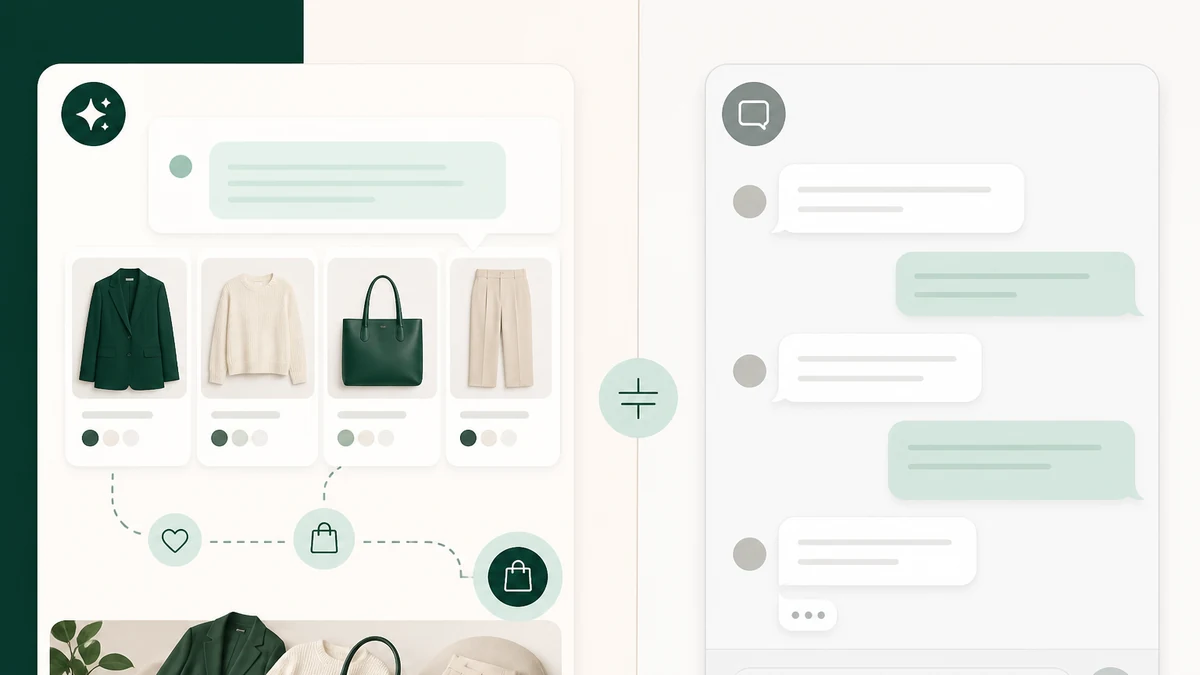
“Chatbot” and “AI shopping assistant” are often used as if they mean the same thing. Both may appear as a messaging interface, but the interface is only the surface. The meaningful difference is the job the system is designed to perform, the information it can use, and the actions it can support.
A chatbot commonly routes support questions or delivers scripted answers. A shopping assistant is centered on product discovery and purchase decisions. Some implementations overlap, so merchants should evaluate capabilities rather than labels.
The simplest distinction: service versus guided shopping
An ecommerce chatbot often begins with operational intent: “Where is my order?”, “What is your return policy?”, or “How do I contact support?” It may use a fixed decision tree, a help-center knowledge base, or a language model connected to approved information.
An AI shopping assistant begins with commercial product intent: “Help me find a wedding guest outfit,” “Which of these jackets is lighter?”, or “What could I wear with this skirt?” It needs access to product information and a way to preserve constraints across the conversation.
Neither role is inherently better. They solve different problems. A merchant may need both, or a single interface with clearly separated product and store-help capabilities.
Compare the systems across five dimensions
1. Primary objective
A support chatbot aims to answer or route a service request efficiently. A shopping assistant aims to help a customer discover and evaluate products. The objective shapes every later decision, including prompts, fallback behavior, data access, and reporting.
2. Source data
Chatbots may rely on policy pages, FAQs, help articles, or support systems. Shopping assistants rely heavily on product catalogs: titles, descriptions, variants, images, categories, attributes, availability, and other approved product fields.
WardrobeIt uses a catalog-only approach for recommendations. Its Catalog-Only Recommendations are designed to stay within the connected merchant assortment, which avoids the ambiguity of sending a customer toward products the store does not sell.
3. Conversation shape
Support conversations are frequently diagnostic: identify the issue, collect the necessary context, then answer or route. Shopping conversations are usually iterative: reveal intent, present options, refine preferences, compare candidates, and support the next action.
4. Product actions
A basic chatbot may link to a collection or product page. A shopping assistant can be designed to maintain product context and support a more continuous path toward product exploration or an eligible cart action. The Add to Cart from the Assistant page describes that shopping-oriented flow.
5. Measurement
Chatbot teams often monitor containment, resolution, routing, and unanswered questions. Shopping-assistant teams should inspect product engagement, conversation quality, discovery paths, and observational commerce outcomes. Revenue associated with an interaction must not be presented automatically as incremental lift.
Why a generic chatbot can struggle with fashion
Fashion discovery uses language that is contextual and subjective. Shoppers combine silhouette, occasion, color, styling, season, and personal preference in one request. Catalogs also vary widely in how those concepts are labeled.
A generic bot may respond fluently without being structured around variants, product relationships, or visual merchandising. Fluency can make unsupported answers sound authoritative. A fashion-first shopping assistant needs constraints that favor grounded product guidance over confident improvisation.
It also needs to understand that an outfit is a collection of decisions. Relevant complementary items should come from the merchant’s own assortment and should respect known constraints. WardrobeIt’s Complete the Look capability focuses on that catalog relationship rather than an open-ended inspiration feed.
Can one interface handle both jobs?
Yes, provided the system keeps the underlying sources and expectations clear. A single widget can help with product discovery and answer approved store questions, but the merchant should know which content governs each response.
Good interface behavior includes:
- recognizing whether the shopper is asking about a product or a store policy;
- using the appropriate approved source;
- keeping product recommendations inside the connected catalog;
- stating when a requested fact is unavailable;
- providing an appropriate next destination when the assistant cannot finish the task; and
- avoiding post-purchase promises that require access the system does not have.
Questions to ask before choosing a solution
Start with the shopper problem, not the technology category. If customers mainly need shipping and return answers, improve support content and routing. If they struggle to translate intent into products, evaluate guided discovery. If both patterns are common, define how one experience will distinguish them.
Then ask operational questions:
- How does the catalog connect and refresh?
- Which product and store-knowledge fields are available to the assistant?
- Can merchants review unanswered or low-confidence questions?
- How are variants and availability handled?
- Which storefront actions are supported today?
- How are usage and outcomes attributed and described?
- What privacy controls apply to shopper-provided information or images?
For a Shopify-first implementation, review the Shopify Integration and the current setup path rather than assuming every ecommerce platform behaves identically.
A practical way to decide
Write down twenty real customer messages and classify them as store help, product discovery, product evaluation, styling, or post-purchase service. This exercise exposes whether the business needs a help bot, a shopping assistant, or a carefully governed combination.
Next, test the same messages against current catalog and policy content. The system cannot reliably answer facts the merchant has never supplied. Improving source data may deliver as much value as changing the interface.
Choose the job before the label
A chatbot is a conversation format; a shopping assistant is a guided-commerce role. Merchants should judge both by grounded answers, useful handoffs, clear limitations, and fit with actual customer missions.
If product discovery is the central problem, explore WardrobeIt’s AI Shopping Assistant. If you are still mapping requirements, the product overview provides a wider view of the connected experience. The right choice is the one whose data and behavior match the customer decision you need to support.