
Why Shoppers Cannot Find Products Already in Your Catalog
Product discovery fails when shopper language, catalog structure, filters, and merchandising context diverge. Learn how to diagnose hidden inventory and improve findability.
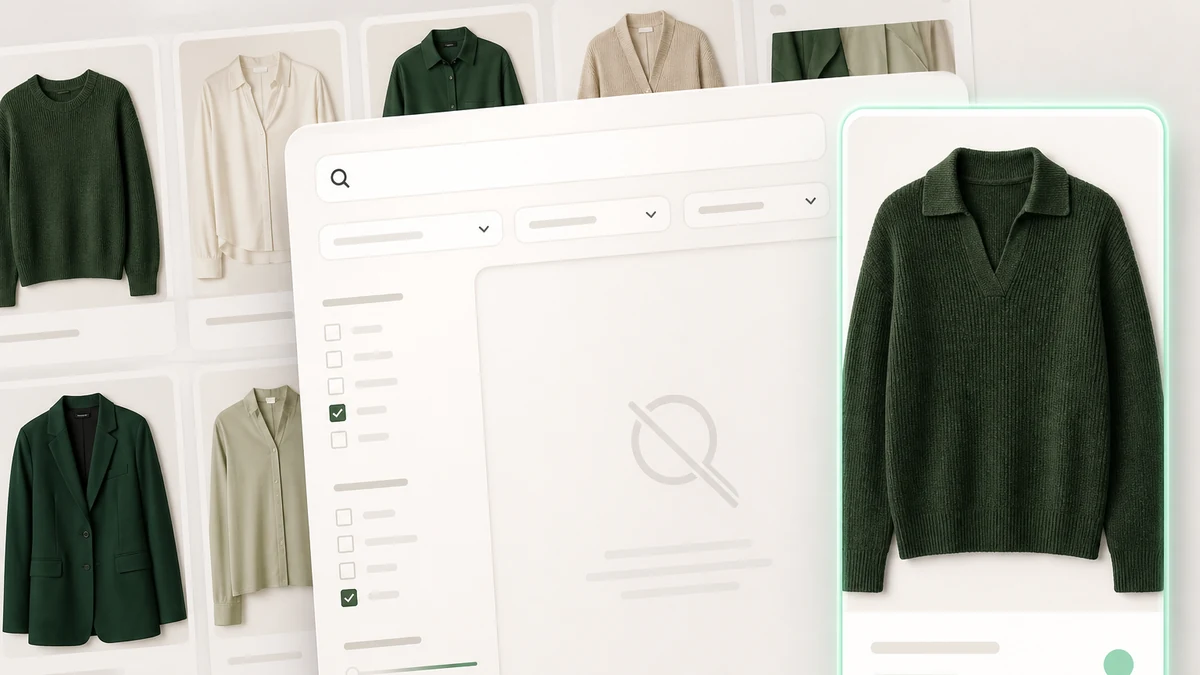
A product can be in stock, published, and visually strong yet remain effectively invisible to the shopper who wants it. The problem is often not assortment. It is translation: the customer describes a need one way while the catalog, navigation, and search system describe it another way.
Finding that gap requires more than looking at zero-result searches. Many discovery failures produce results—just not useful ones.
Shoppers search in missions; catalogs store attributes
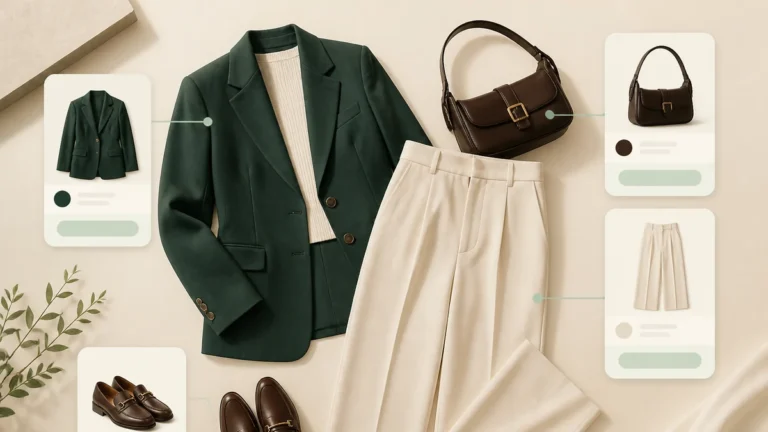
A fashion catalog is usually organized around operational fields such as product type, vendor, collection, color, size, tags, and availability. A shopper may think in terms of a moment: “a comfortable outfit for a work dinner,” “a layer for unpredictable spring weather,” or “shoes that make this dress feel less formal.”
Those requests contain context that may never appear verbatim in a product title. Keyword matching can therefore miss relevant inventory even when every item is correctly entered.
Seven common causes of hidden inventory
1. Vocabulary mismatch
The shopper says “overshirt,” while the catalog says “shacket.” They search “burgundy,” while the product color is “wine.” Synonyms, regional language, trend language, and informal descriptions all create distance between intent and metadata.
2. Sparse product information
A short title and a generic description provide little material for discovery. If silhouette, occasion, texture, closure, length, or styling details matter to the purchase, those facts should be represented consistently and accurately.
3. Inconsistent taxonomy
Two similar garments may be assigned to different product types or tagged at different levels of detail. Filters then split a coherent assortment into arbitrary pockets. Consistency matters more than creating a large number of tags.
4. Rigid navigation
Collection menus reflect the merchant’s structure, not necessarily the shopper’s route. A customer who does not know whether an item belongs under knitwear, tops, or occasionwear may choose the wrong branch and assume the product is unavailable.
5. Overly literal search
Literal search can treat a multi-part request as a bag of terms. It may overvalue one word, ignore relationships among constraints, or return nothing because the exact phrase is absent.
6. Filter dead ends
Filters can narrow efficiently, but shoppers may apply combinations that produce tiny or empty sets. If the interface does not explain which constraint removed the options, recovery becomes guesswork.
7. Missing merchandising context
A product may become relevant only in relation to another item. A skirt found on its own does not answer “what top works with this?” Discovery should support relationships when the catalog contains appropriate candidates.
How conversational discovery changes the path
Conversational discovery lets the shopper state a broader need and refine it across turns. The system can preserve the context of the original request while helping the customer narrow by available attributes.
For example, the shopper may start with “an easy travel outfit.” The next turn can clarify climate, formality, preferred color, or garment type. This does not require the system to invent a definition of “easy.” It should connect the shopper’s language to documented product facts and present options that can be inspected.
WardrobeIt’s Conversational Product Discovery is designed for this intent-led route, while Catalog-Only Recommendations keeps the resulting suggestions within the connected assortment.
Fix the catalog before blaming the interface
Conversational tools are not a substitute for product-data hygiene. They can interpret language more flexibly, but their explanations still depend on source information.
Run a focused catalog review:
- Select representative products across major categories and price points.
- List the questions a shopper would ask before choosing each item.
- Check whether the catalog contains accurate answers to those questions.
- Normalize high-value attributes and controlled vocabulary.
- Remove tags that are ambiguous, obsolete, or used inconsistently.
- Verify variants, availability, imagery, and product URLs.
The Shopify Catalog Sync overview explains the role of a connected catalog in WardrobeIt. Syncing does not repair weak source data by itself; it makes the current catalog available to the experience.
Use real shopping missions for testing
Test cases should include more than known product names. Build a set from customer questions, merchandising themes, support conversations, and common occasions. Include broad requests, conflicting constraints, misspellings, synonyms, and questions whose answers are genuinely absent.
For each mission, evaluate four things:
- Relevance: Are the options defensible given the request?
- Coverage: Did the experience overlook plausible in-catalog products?
- Grounding: Can the explanation be traced to known information?
- Recovery: Does the shopper get a useful next step when no exact match exists?
Measure discovery as a journey
Zero-result rate is useful but incomplete. Examine query reformulation, category exits, filter removal, product-detail visits, assistant follow-up turns, and unresolved questions. Qualitative review is essential because a seemingly successful result may still misunderstand intent.
Connect these observations to merchandising work. Repeated requests for an attribute may signal a metadata gap. Repeated requests for unavailable combinations may reveal an assortment opportunity, but they are not proof of demand until evaluated in context.
Make inventory understandable
When shoppers cannot find products already in the catalog, adding traffic simply sends more people into the same discovery gap. The durable fix combines clean product data, flexible paths, transparent constraints, and continuous review.
Begin with ten important shopping missions and trace each from initial language to a defensible product set. Fix the source data where it fails, then evaluate whether guided conversation can shorten the route. Explore WardrobeIt’s Improve Product Discovery solution for a catalog-grounded approach.