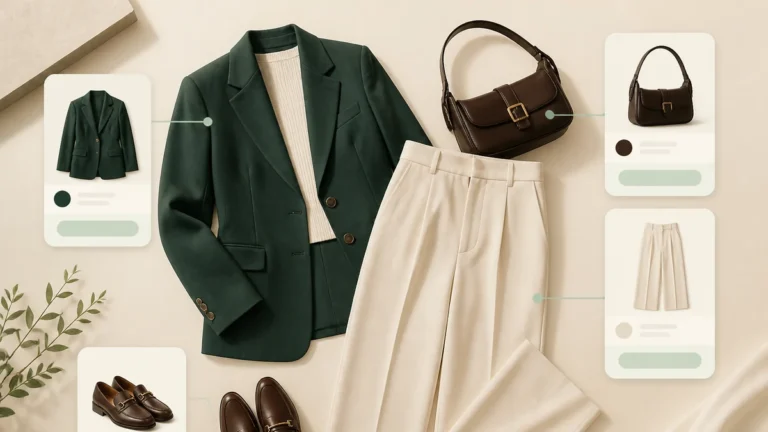

Conversational Product Discovery: A Better Way to Search Fashion Catalogs
Conversational discovery helps fashion shoppers express occasions, preferences, and constraints naturally, then refine catalog results without restarting rigid searches or leaving merchant inventory.

Fashion shoppers rarely arrive with database-ready queries. They arrive with occasions, uncertain preferences, partial constraints, and a picture in their mind. Conversational product discovery gives them a way to express that context naturally and refine it without rebuilding a search from scratch.
The goal is not to make search sound more human. It is to make the route from intent to verifiable catalog options more useful.
Why fashion search is unusually contextual
A request for a laptop charger can often be resolved through compatibility and model number. A request for an outfit may combine formality, silhouette, color, weather, styling confidence, budget, and compatibility with an item the shopper already owns.
Some of those constraints are objective catalog facts. Others are subjective preferences that require clarification. A responsible discovery experience distinguishes between them. It can use “midi length” when the catalog supports that attribute, but it should treat “flattering” or “perfect for me” as personal judgments rather than guaranteed facts.
What conversational discovery looks like
The shopper begins with a broad request. The assistant interprets the available constraints, presents a focused set or asks a useful question, and carries context into the next turn.
A practical flow might be:
- The shopper asks for a lightweight layer for a smart-casual trip.
- The experience identifies relevant categories and known seasonal or material details.
- It asks whether the shopper prefers a structured or relaxed direction.
- The shopper adds a budget or color preference.
- The experience updates the in-catalog options and explains the known differences.
This is different from placing a chat box beside an unchanged search endpoint. The conversation must preserve constraints and connect them to product records.
Four principles for useful results
Ground every option in the catalog
Recommendations should point to actual products and current variants available through the connected merchant catalog. WardrobeIt’s Catalog-Only Recommendations approach is intended to avoid outside-product drift.
Ask questions that materially narrow the set
A follow-up should earn its place. Asking about color when every available option is black wastes time. Asking about formality when the catalog spans evening and casual styles may significantly improve relevance.
Explain with known facts
Useful explanations identify why an item may fit the stated request using visible product information. They should not invent comfort, fit, quality, or compatibility claims.
Make recovery easy
If no product satisfies every constraint, the assistant should say so and help the shopper relax or prioritize one condition. A transparent near-match is more useful than a confident false match.
How it complements filters and collections
Conversational discovery does not need to replace familiar storefront controls. Filters are efficient for shoppers who understand the taxonomy and know which attributes matter. Collections are effective merchandising surfaces. Product pages remain the primary place to verify details.
Conversation can act as an alternate entry point and a bridge among those surfaces. It can help the customer identify useful constraints, then direct them to a product or curated set. The strongest experience lets shoppers move between guided and self-directed exploration without losing context.
Preparing a Shopify fashion catalog
A Shopify-first implementation should start with the source catalog. Review titles, product types, descriptions, options, variants, tags, collections, images, availability, and URLs. Decide which fields are authoritative for important claims.
Prioritize attributes that affect real decisions:
- garment category and subcategory;
- color names and useful color families;
- materials and care information when documented;
- length, sleeve, closure, and silhouette descriptors;
- occasion or styling context when approved by merchandising;
- variant availability and price; and
- relationships among items intended to coordinate.
Do not create attributes merely to satisfy a system. Use language the merchandising team can maintain accurately. The Shopify Integration page provides the current platform context for WardrobeIt.
Supporting outfit-level discovery
Fashion shopping often expands from one product to a look. Once a shopper identifies a jacket, the next question may be which trousers or accessories make sense with it. That relationship should still be bounded by the merchant’s assortment and known product information.
WardrobeIt’s Complete the Look capability supports catalog-based outfit exploration. It should be evaluated as decision support, not as a claim that one combination is objectively correct for every shopper.
Testing quality before launch
Create a mission set that reflects actual customers rather than internal category labels. Include occasion-led requests, attribute-led requests, broad inspiration, budget constraints, comparisons, and impossible combinations. Add cases where the correct response is uncertainty.
Review the output with merchandising and customer-service teams. Merchandising can identify irrelevant combinations or missing attributes. Service teams can identify ambiguous questions and policy boundaries. Record failures by source: catalog gap, interpretation error, ranking issue, unsupported claim, or weak recovery.
Measure learning, not just clicks
Track whether shoppers engage with relevant products, continue refining, reach product details, and encounter unanswered questions. Review conversation samples under appropriate privacy controls. Commerce outcomes can provide additional context, but participation in a journey is not equivalent to incremental impact.
The Usage and Outcome Analytics page explains WardrobeIt’s approach to observing assistant usage and outcomes.
Build a shorter path from intent to evidence
Conversational product discovery is better than rigid search when it helps shoppers express context, narrows only on usable information, and makes every recommendation inspectable. It is worse when fluent language disguises weak catalog grounding.
Start small: choose one category, define twenty real missions, clean the attributes those missions require, and evaluate the full conversation. When the system can consistently turn natural intent into defensible in-catalog options, expand carefully. Visit Improve Product Discovery to see how WardrobeIt approaches that path.